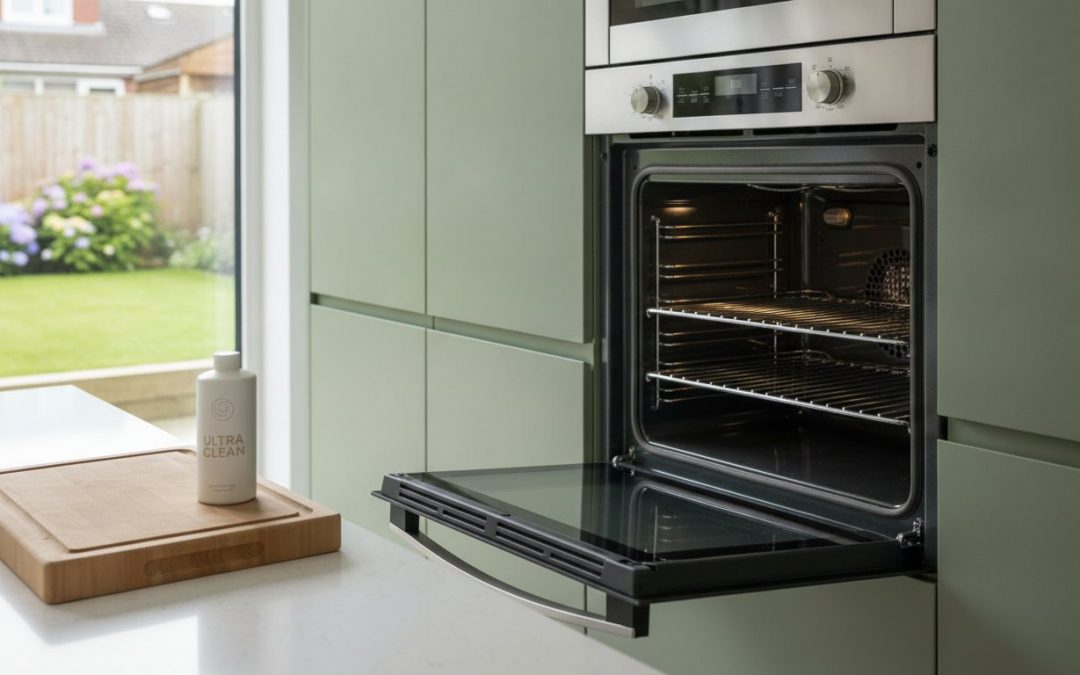
You’ve spent the morning scrubbing every inch of the racks, yet the moment you turn the dial to roast Sunday lunch, that familiar, acrid stench returns to fill your kitchen. It’s incredibly frustrating when a supposedly clean appliance still triggers the smoke alarm or leaves your house smelling like a bonfire. If you’re struggling with a stubborn oven cleaning for burnt food smell, you aren’t alone; many of my local clients find that standard supermarket sprays just don’t touch the root of the problem.
I understand how worrying it is to think about your family inhaling carbon particles or having a beautiful meal ruined by a lingering bitter taste. Whilst a surface wipe helps, the real culprit is usually carbonised grease hidden behind the fan cover or baked into the heating elements. In this guide, I’ll explain why these smells persist and how a professional deep clean provides a permanent solution. You’ll discover how to return your kitchen to a fresh, hygienic state and ensure your oven operates safely without the constant worry of smoke or unpleasant odours.
Key Takeaways
- Understand how vapourised fats and carbonised debris hide behind fan covers and heating elements, causing persistent odours every time you cook.
- Learn why common household remedies like vinegar or baking soda only mask smells temporarily rather than removing the burnt carbon source.
- Discover how professional oven cleaning for burnt food smell uses specialist equipment to reach hidden areas that standard domestic cleaning simply cannot access.
- Explore the benefits of using van-mounted heated dip tanks to completely strip away stubborn carbon from racks, trays, and side liners.
- Restore your kitchen to a fresh-smelling and hygienic environment whilst ensuring your appliance operates safely without triggering smoke alarms.
Understanding Why Burnt Food Smells Linger in Your Oven
Many homeowners assume that a quick wipe with a sponge is enough to stop the stink. The reality of oven cleaning for burnt food smell is more complex than simply clearing away visible crumbs. When food spills or splashes, it doesn’t just sit on the bottom. At high temperatures, fats and juices vapourise, turning into microscopic particles that travel throughout the oven cavity. These particles bond to existing layers of grease on the walls and ceiling, creating a sticky, odorous film that reactivates every time you turn on the heat.
Heating these trapped particles repeatedly leads to the formation of Polycyclic Aromatic Hydrocarbons (PAHs). These aren’t just unpleasant; they are carbonised pollutants that shouldn’t be circulating in your kitchen air or settling on your fresh meals. Simply wiping the floor of the appliance leaves these microscopic layers untouched on the grill elements and tucked behind the side liners, where they continue to smoulder and release acrid fumes.
The Science of Carbonised Debris and Smoke Particles
Carbonisation occurs when organic matter is subjected to intense heat, leaving behind a concentrated carbon residue. This residue acts like a sponge for acrid scents. Whilst some high-end appliances use a pyrolytic cleaning process to turn this debris into ash, most standard ovens just bake it on harder. I’ve often seen how an oven’s cooling fan pulls this smoke into the internal housing, effectively trapping the smell in areas you can’t see or reach without specialist tools.
Common Culprits: From Burnt Bread to Overcooked Fats
I find that dry burns, such as a forgotten piece of toast, produce a light ash that travels easily on air currents throughout the kitchen. Greasy burns from roasting joints of meat are far more stubborn because the oils act as a binder for the soot, making it much harder to shift. A fat’s smoke point is the specific temperature at which it begins to break down and produce continuous smoke, which is the exact moment those persistent, burnt kitchen odours are born in 2026.
Comparing DIY Odour Removal vs. Professional Deep Cleaning
I often meet homeowners who have spent an entire Saturday morning trying to scrub away a stubborn stench with a bowl of vinegar or a handful of lemons. Whilst these natural remedies might provide a temporary citrus scent, they simply cannot address the chemical reality of why burnt food smells linger. These methods are masking agents; they sit on the surface whilst the source of the odour remains baked onto the internal components.
The difference in results comes down to the depth of the clean and the tools used. A typical DIY attempt involves about four hours of back-breaking scrubbing, yet usually fails to reach the back of the fan or the roof of the cavity. My professional valeting process takes around two hours and achieves a level of restoration that domestic products cannot match. If you want a fresh kitchen without the hard labour, choosing a professional oven valet is a sensible investment.
Why Supermarket Solutions Often Fail
Off-the-shelf sprays are often highly caustic and emit fumes that are just as unpleasant as the burnt food itself. These chemicals can be aggressive, potentially damaging delicate glass seals or causing discolouration on stainless steel surfaces. For my clients across Greater London, I prefer using specialised, non-caustic solutions. These products are effective against thick carbon deposits but are completely safe for use in busy family homes with children and pets.
The Professional Advantage: Reaching the ‘Unreachable’
Effective oven cleaning for burnt food smell requires more than a surface wipe. When I visit homes in Ruislip and Harrow, I take the time to dismantle the oven door and the fan housing to extract hidden soot and grease that domestic cleaners simply cannot reach. My van is equipped with a heated dip tank, which allows me to soak racks, trays, and grill pans in a specialised solution that strips away carbonised debris whilst I work on the main unit. This thorough approach ensures that even the most stubborn smells are eliminated from the source, protecting your grill elements from electrical faults caused by grease buildup.

How Professional Oven Cleaning Eliminates Odours for Good
I believe that a truly fresh kitchen starts with a methodical approach to restoration. When I arrive to perform an oven cleaning for burnt food smell, I don’t just spray and wait. My process begins with a full inspection of the appliance to identify exactly where those carbonised particles are hiding. I then remove all detachable parts, including the racks, trays, and even the fan cover, to ensure no grease is left behind. This thoroughness is what sets a professional valet apart from a standard domestic wipe-down.
The secret weapon in my restoration kit is the van-mounted heated dip tank. Whilst I am busy inside your home performing a deep manual scrub of the oven cavity, your racks and trays are soaking in a specialised, non-caustic solution outside. This system strips away years of baked-on carbon that a domestic dishwasher or kitchen sink soak simply can’t touch. Once the components are rinsed and reinstalled, your oven is ready to use immediately. There are no harsh chemical smells or clouds of smoke when you next turn it on; you’re left with a clean, hygienic appliance that’s safe for your next family meal.
Our Certified Restoration Process
My restoration service follows a strict three-phase system: inspection, component removal, and the deep-scrub phase. I pay particular attention to the roof of the oven and the areas behind the liners where grease often gathers unnoticed. ‘Using fume-free, eco-friendly chemicals is the only way to ensure a modern kitchen remains a safe space for cooking and family life immediately after a professional clean.’ This commitment to safety means you can get back to roasting or baking the moment I pack up my tools.
Booking Your Local Specialist in South West and North West London
I provide this thorough service across a wide range of local communities, including Watford, Richmond, and Kingston. If you live in Pinner, Uxbridge, or Twickenham and are dealing with a burnt food emergency, I am here to help. I’ve built my reputation on being a reliable neighbour who isn’t unfazed by even the most neglected appliances. Getting your kitchen back to its best is straightforward. Simply reach out for a clear, no-obligation quote, and I’ll help you schedule a visit to eliminate those stubborn odours for good.
Enjoy a Fresh, Smoke-Free Kitchen Again
You don’t have to tolerate a kitchen that smells like a bonfire every time you prepare a meal. Stubborn odours are rooted in carbonised grease trapped behind fans and on heating elements that standard kitchen sprays simply can’t reach. My specialised oven cleaning for burnt food smell service is designed to tackle these hidden layers, removing the source of the stench rather than just covering it up. By choosing a professional restoration, you ensure your appliance is safe, hygienic, and ready for use immediately.
I provide certified cleaning for both domestic and commercial appliances across Greater London and Hertfordshire, including Watford and Richmond. My process is entirely eco-friendly and non-caustic, so your home remains a safe environment for your family throughout my visit. I take genuine pride in my hardworking, meticulous approach to every job, ensuring your oven returns to its original condition. Book your professional oven restoration with Premium Oven Cleaner today and look forward to a kitchen that smells as good as your cooking.
Frequently Asked Questions
Is it safe to use my oven if it smells like it’s burning?
It is not safe to continue using an oven that produces a persistent burning smell. If your appliance is smoking or smelling acrid, it usually means carbonised food or grease is catching fire or vapourising. This can trigger smoke alarms and release harmful particles into your kitchen air. I always advise my clients to stop using the unit until it has been properly cleaned to avoid the risk of a grease fire.
How long does a professional oven cleaning take to remove bad smells?
A standard professional visit typically takes around two hours to complete. During this time, I perform a deep valet that reaches into every corner of the appliance to ensure a total restoration. Unlike a quick DIY wipe, this thorough process is specifically designed for oven cleaning for burnt food smell, ensuring the odour is gone the moment I finish. You can use your oven for cooking immediately after I leave.
Can a burnt food smell indicate a mechanical fault in the oven?
Yes, whilst most smells are caused by old food debris, a sharp, metallic, or plastic scent can indicate a mechanical fault. If the smell is accompanied by visible sparks or if it persists even when the oven is empty and clean, it might be an electrical issue with the heating element or wiring. In these cases, I recommend having a qualified technician inspect the appliance for safety before further use. Maintaining your home’s essential appliances is a key part of household safety; for those based in West Sussex, a professional boiler installation bognor regis from WellPlumbed is an excellent example of the expert care needed to keep your property running safely.
Will professional cleaning remove the smell from the convection fan?
Yes, I specifically dismantle the fan housing to clean the blades and the area behind the cover. This is a common spot where vapourised fats collect and solidify, causing a lingering oven cleaning for burnt food smell every time the fan circulates hot air. By removing this hidden grease, I can effectively eliminate the scent that domestic cleaning methods often miss. This ensures the air circulated is fresh and clean.