Did you know that cleaning remains the leading cause of tenancy deposit disputes in the UK, with 56% of all cases citing it as a primary reason for a claim? I know how stressful it is to hand over the keys whilst worrying about baked-on carbon or that stubborn grease on the hob. Whether you’re a landlord prepping for a fresh start or a tenant wanting your money back, getting oven cleaned for new tenants is often the difference between a smooth move and a fortnight of legal headaches. It is frustrating to spend hours scrubbing only to be told the finish isn’t “professional” enough for the inventory clerk.
I’ve put together this professional-standard checklist for 2026 to help you achieve a crystal-clear finish that passes any inspection the first time. This guide will walk you through the latest legal requirements under the Renters’ Rights Act and the specific areas that must sparkle to protect your deposit. We’ll cover everything from restoring the original condition of the racks to ensuring the glass door is completely transparent for the new arrivals, giving you total peace of mind during the move-out process.
Key Takeaways
- Understand why inventory clerks prioritise the oven during check-out and how to avoid the most common cause of deposit deductions in 2026.
- Learn the exact difference between a domestic scrub and the “professional standard” required when getting oven cleaned for new tenants to meet your legal obligations.
- Use our detailed checklist to target hidden grease traps, such as the often-overlooked space between glass door panes and the oven roof.
- Discover why supermarket cleaning kits and DIY methods often fall short of the rigorous standards expected during a formal property handover.
- Ensure a smooth move-out process and protect your financial interests by achieving a crystal-clear finish that passes inspection the first time.
The Handover Reality: Why Ovens Top the Deposit Dispute List in 2026
In the busy rental markets of Watford and Richmond, inventory clerks follow a very specific routine. The oven is almost always their first port of call. It serves as the ultimate litmus test for the rest of the property. If the oven is sparkling, clerks often assume the house has been well cared for. If it is coated in thick grease, they will look much closer at every other corner of the home. Ovens are the focal point of the kitchen, and their condition sets the tone for the entire inspection.
Getting oven cleaned for new tenants is a critical step because of the “professional standard” clause found in most modern agreements. This doesn’t mean you are legally forced to hire a specialist, but it means the result must match a professional finish. Since the Tenant Fees Act 2019, landlords cannot mandate that you use a specific cleaning company. However, they can still claim from your deposit if the appliance isn’t returned in the same state it was at the start of the tenancy. A dirty oven isn’t just an eyesore; it’s a hygiene risk that suggests a lack of general maintenance.
The Cost of a Failed Inventory Inspection
Carbon deposits and greasy hobs lead to immediate deposit deductions. I often see tenants surprised when they lose fifty pounds because of a “slightly” dirty rack. The ‘Cat Theory’ of cleaning explains this perfectly. Just as pet owners become blind to the smell of their own cat, tenants often become blind to the gradual build-up of grease in their kitchen. You might think it looks fine, but an agent with a fresh pair of eyes will see every burnt-on spill. Even if your appliance features self-cleaning oven technology, these pyrolytic or catalytic cycles often miss the racks and the glass panes where grease hides.
Landlord Obligations vs Tenant Responsibilities
Landlords have a duty to provide a hygienic start for every new resident. Investing in a pre-tenancy deep clean ensures the property is attractive and helps maintain the long-term value of the appliances. For the tenant, the responsibility is to return the oven in the same condition, allowing for fair wear and tear. It’s important to remember that “wear and tear” refers to things like faded markings on dials, not layers of carbonised food. A clean oven creates a positive first impression, making the new tenants more likely to look after the property themselves.
The Ultimate Pre-Tenancy Oven Cleaning Checklist
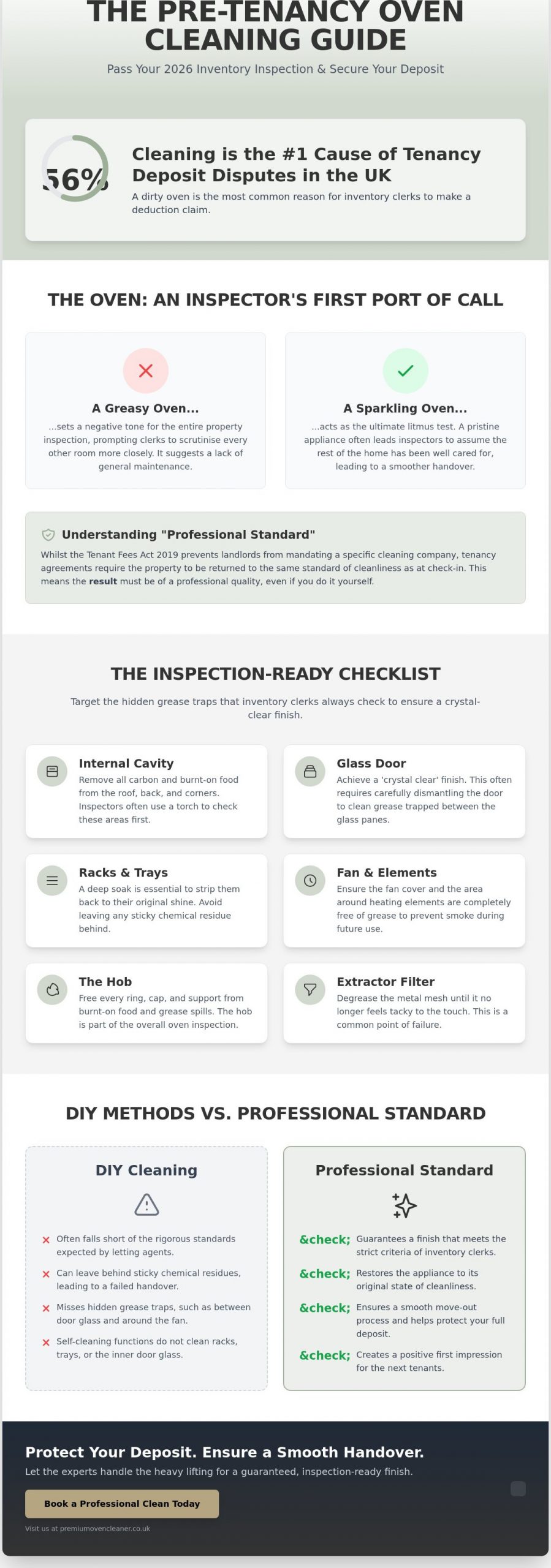
Now that you understand the stakes, achieving that inspection-ready finish requires a methodical approach. According to government guidance on property cleanliness, both parties have a vested interest in the appliance’s condition. Getting oven cleaned for new tenants isn’t just about a quick wipe; it’s about restoring every surface to its original state. I recommend starting with the internal cavity. You must remove all traces of carbon and burnt-on food from the roof and corners, as these are the first places an inspector will check with a torch.
The glass door is your next priority. To pass the test, you need a ‘crystal clear’ finish. This often involves carefully dismantling the door to reach the grease that hides between the panes. For the racks and trays, I find that a deep soak is the only way to strip them back to their original shine. Avoid leaving any sticky chemical residue, as this is a common reason for a failed handover. Don’t forget the ‘extras’ that complete the kitchen:
- The Hob: Ensure every ring and support is free of burnt-on spills.
- Extractor Filter: Degrease the mesh until it no longer feels tacky.
- Warming Drawer: Vacuum out any crumbs and wipe down the interior.
If the task feels like too much of a mountain to climb, I can certainly help with a professional oven cleaning service that handles the heavy lifting for you.
The ‘Professional Standard’ Internal Checklist
A true deep clean goes beyond what’s visible at a glance. I always pay close attention to the fan cover and the area around the heating elements. These must be free of grease to prevent smoke during future use. Make sure the light cover is transparent so the bulb actually illuminates the food. Finally, use a specialised scraper to remove all ‘brown spotting’ from the enamel surfaces without scratching the finish.
External and Functional Finishing Touches
The outside of the oven matters just as much for that first impression when getting oven cleaned for new tenants. Degrease all control knobs and the display panel carefully. I’ve seen many people accidentally rub off the temperature markings by using harsh chemicals, so be gentle. Polish the stainless steel or enamel exterior until it’s smear-free. Lastly, check the door seals for trapped crumbs or grease build-up. A clean seal ensures the oven operates efficiently for the next tenant.
Why DIY Often Fails the Handover Test
It is tempting to grab a supermarket ‘dip-tank’ kit from the local shop, but these domestic products rarely reach the standard required for a formal handover. Most off-the-shelf solutions are caustic and difficult to use safely. They often fail to remove the stubborn carbon deposits that a professional-grade heated tank handles with ease. Getting oven cleaned for new tenants is about more than just a surface wipe; it’s about deep restoration that domestic sponges simply can’t achieve.
Hidden grease is the most common reason for a failed first impression. If a new tenant moves in and smells smoke during their first Sunday roast, it’s a major red flag that the property wasn’t properly prepared. I often find thick layers of grease behind the fan cover or tucked into the roof corners where DIY efforts stop. There is also the risk of damage. Amateur scrubbing with wire wool can easily scratch an expensive AGA or leave permanent marks on a delicate ceramic hob. These mistakes are costly to fix and can lead to the very deposit deductions you were trying to avoid.
Landlords in areas like Harrow and Uxbridge tell me that time is their most valuable asset. Outsourcing the job allows them to handle the mountain of move-in paperwork whilst I ensure the kitchen is spotless. It’s a practical solution that guarantees a result no domestic kit can match.
The Premium Oven Cleaner Difference
I use an eco-friendly, fume-free process that is completely safe for your home. Unlike the harsh chemicals found in shops, my method allows the new residents to start cooking immediately after they move in. Whether you need specialist care for an AGA, a deep clean for a microwave, or a sparkling hob, I provide a thorough service across the Greater London area. Book your pre-tenancy deep clean with Premium Oven Cleaner today to ensure your kitchen is ready for its next chapter.
Peace of Mind for London Landlords
I understand the importance of evidence in the rental market. That is why I provide a ‘Certified Clean’ receipt for every job, which serves as vital proof for your inventory report. My service covers local areas from Ruislip to Kingston, offering a punctual and professional solution that takes the stress out of the move-out process. You can trust that the job will be done right, leaving the oven in a condition that any inventory clerk would approve of.
Secure Your Deposit and Welcome Your New Tenants
Handing over a property is stressful enough without worrying about the state of the kitchen. As I’ve discussed, the oven is often the first place an inventory clerk looks, making it the most common source of deposit friction in 2026. By following a thorough checklist and understanding the difference between a domestic wipe and a professional restore, you can avoid these disputes entirely. Getting oven cleaned for new tenants ensures a hygienic start for the new occupants and provides you with the peace of mind that your financial interests are protected.
If you want to guarantee an inspection-ready finish without the hard labour, I am here to help. I am a fully certified and insured local specialist using fume-free, eco-friendly cleaning solutions. I serve Watford, Harrow, and the rest of Greater London, providing the ‘Certified Clean’ receipt you need for your records. Get a quote for your rental property oven clean today and let me handle the heavy lifting. You’ve got enough to do with the move; leave the scrubbing to a professional who cares about the result as much as you do.
Frequently Asked Questions
Can a landlord force a tenant to pay for a professional oven clean?
No, landlords in England cannot legally mandate that you pay for a professional cleaning service under the Tenant Fees Act 2019. You are only required to return the oven to the same standard recorded at check-in. However, getting oven cleaned for new tenants to a professional standard is often the only way to match the baseline documented in your original inventory and secure your full deposit.
What happens if the oven isn’t clean when new tenants move in?
If the oven is dirty when you move in, you must document it with photographs and notify your landlord or letting agent immediately. This ensures the baseline for your tenancy is accurate so you aren’t held responsible for previous grease. For landlords, failing to provide a clean oven creates immediate friction and may lead to a formal request for a remedial clean before the tenants use the kitchen.
How long does a professional end-of-tenancy oven clean take?
A professional end-of-tenancy oven clean typically takes between two and four hours. A standard single oven usually takes about two hours, whilst larger double ovens or range cookers with multiple cavities can require up to four hours. The exact time depends on the size of the appliance and the level of carbon build-up that needs to be stripped away to meet the inventory standard.
Is it worth getting the hob and extractor cleaned at the same time?
Yes, it is definitely worth cleaning the hob and extractor at the same time. Inventory clerks look at the entire cooking area as one unit, and a greasy extractor can quickly fail an inspection. Getting oven cleaned for new tenants is most effective when the whole set is restored, ensuring no sticky residue or old smells remain to trigger a dispute or ruin a new tenant’s first meal.
Will a professional clean remove all carbon deposits from an old oven?
Yes, my professional process will remove all burnt-on carbon deposits, even in older appliances. I use specialist dip tanks and precision tools to reach the corners and roofs that domestic products cannot touch. Whilst I can’t repair physical damage like deep enamel scratches or worn-out seals, I can guarantee that every trace of grease and carbonised food will be gone, leaving the interior smooth and hygienic.
Do I need to be present at the property whilst the oven is being cleaned?
You don’t need to be present at the property while I work. I often arrange key collection from estate agents or neighbours across Watford and Harrow to make the process simple for you. As long as I have access to electricity and a sink, I can work independently whilst you focus on the rest of your move. This ensures the job gets done to a professional standard without you needing to wait around.